
Extension and Optimization of Reactive Flow Capabilities in the Basilisk Framework
Context:
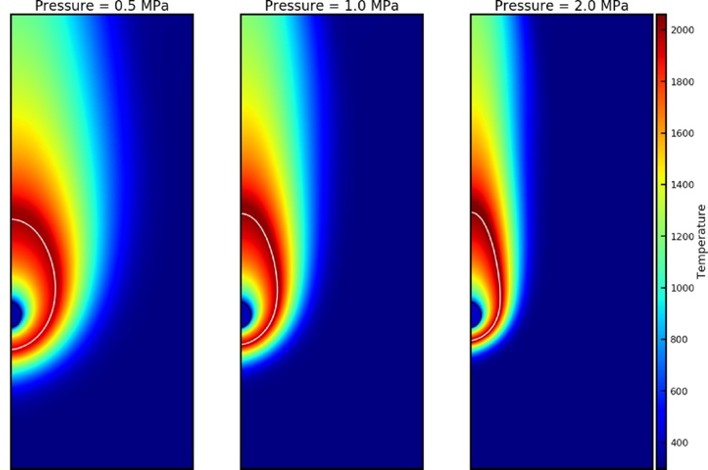
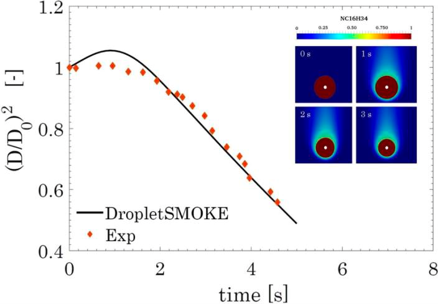
Basilisk (https://basilisk.fr) is an open-source CFD framework designed for adaptive mesh refinement (AMR) in fluid dynamics, particularly well-suited to multiphase and free-surface flow problems. A recent research effort within the CRECK Modeling Lab has led to a major extension of Basilisk: it now supports heat transfer and reactive flows with detailed chemical kinetics, including arbitrarily large mechanisms. This opens the possibility of simulating combustion systems within a dynamically adaptive and highly efficient computational framework.
However, the current implementation of the chemical source term evaluation and thermophysical property handling remains in an early-stage and needs to be improved and optimized to make large-scale simulations practically feasible. This MSc thesis project focuses on the refinement, optimization, and further extension of the reactive capabilities in Basilisk, with the ultimate goal of enabling high-fidelity, massively parallel simulations of reactive flows in complex geometries.
Objectives:
- Improve and optimize the computation of chemical source terms
- Implement cell agglomeration strategies for reducing the number of stiff systems to integrate during the chemical step.
- Introduce on-the-fly mechanism reduction, based on local conditions and flux-based criteria, to handle large kinetic models efficiently.
- Extend the thermophysical model to support variable transport properties, heat capacities, and equation-of-state consistency.
- Test and benchmark the implementation on reactive benchmark problems with increasing complexity, including multi-dimensional and parallel simulations.
Expected Outcomes:
- An extended version of Basilisk with robust and efficient handling of combustion chemistry.
- New modules for adaptive chemical model reduction, integrated with the mesh refinement.
- Benchmarks and performance evaluations of the optimized code on 2D/3D combustion test cases.
Supervisor:
Prof. Alberto Cuoci
CRECK Modelling Lab, Politecnico di Milano